Bazi—also called the Eight Characters, Four Pillars of Destiny, or Four Pillars—is a traditional Chinese system of analysis. It starts with a person's birth year, month, day, and hour, then converts that time into Heavenly Stems and Earthly Branches. The result contains eight Chinese characters, which is why the system is called Bazi, or “eight characters.”
For example, a chart calculated from a birth time might produce: Jia-Zi, Bing-Yin, Xin-You, and Wu-Xu.
Each pair forms one pillar: the Year Pillar, Month Pillar, Day Pillar, and Hour Pillar. Four pillars contain eight characters in total.
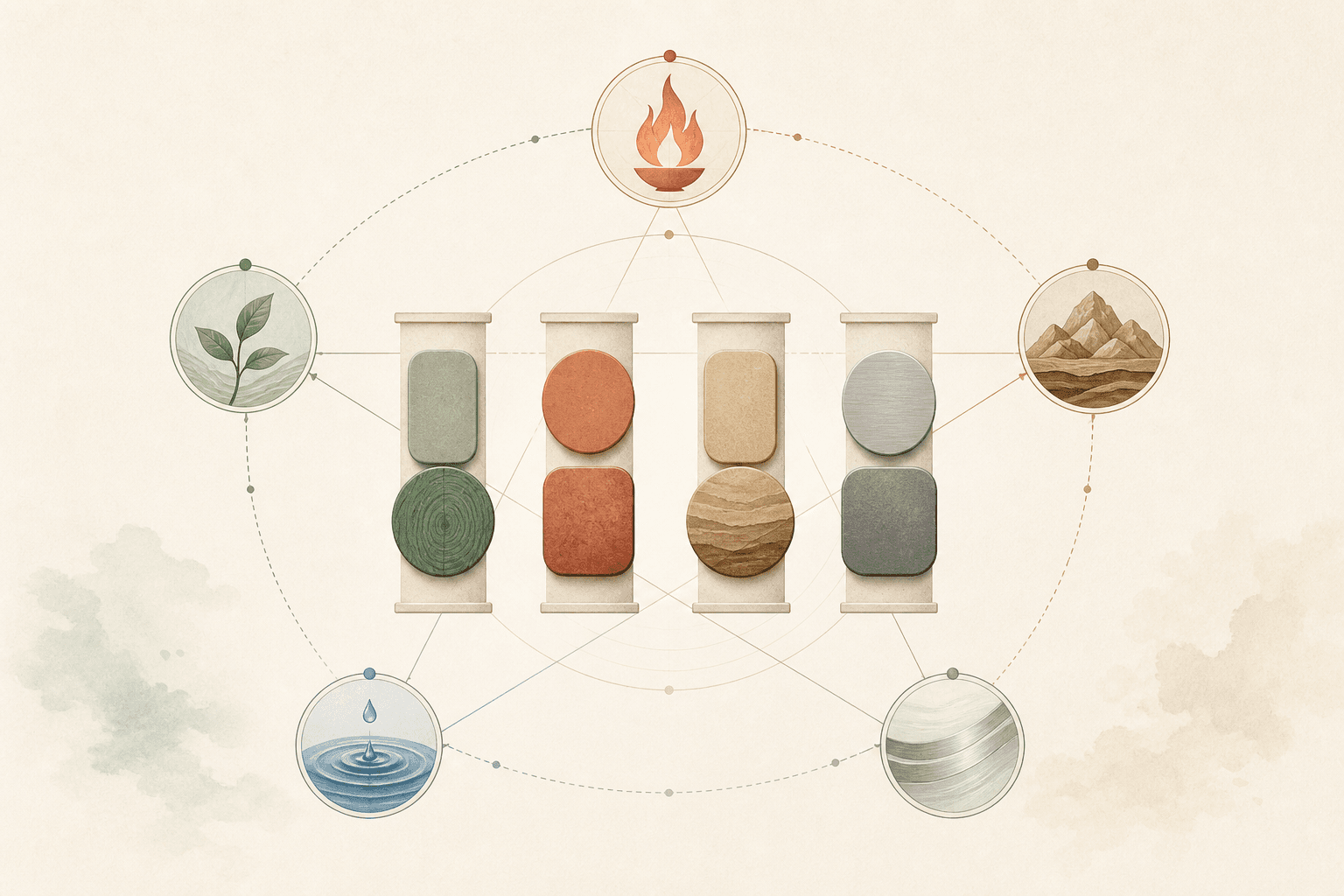
In traditional Bazi theory, these characters are not interpreted in isolation. Analysis also considers the Heavenly Stems, Earthly Branches, yin and yang, the Five Elements, Day Master, Ten Gods, luck cycles, and annual influences, together with the relationships that form across the chart.
- Year Pillar
- Month Pillar
- Day Pillar
- Hour Pillar
Why is Bazi also called the Four Pillars?
Bazi divides a birth time into four parts—year, month, day, and hour. Each part is represented by one Heavenly Stem and one Earthly Branch, forming the Year, Month, Day, and Hour Pillars.
Year Pillar
The Year Pillar contains the stem and branch assigned to the birth year.
In traditional interpretation, it is often associated with early environment, family background, and wider social context.
A Bazi year does not necessarily begin on January 1. Four Pillars calculations normally use solar-term boundaries, so knowing a person's zodiac animal is not enough to determine the full chart.
Month Pillar
The Month Pillar contains the stem and branch assigned to the birth month.
It is especially important because it is closely tied to the season at birth. The season affects the relative strength of the Five Elements.
Element strength therefore cannot be judged by counting appearances alone; the birth month and season also matter.
- Wood is generally stronger in spring
- Fire is generally stronger in summer
- Metal is generally stronger in autumn
- Water is generally stronger in winter
Day Pillar
The Day Pillar contains the stem and branch assigned to the birth date.
Its Heavenly Stem is called the Day Master, or Day Stem, and serves as a central reference point in Bazi analysis.
If the Day Pillar is Jia-Zi, the Day Master is Jia Wood. If it is Ding-You, the Day Master is Ding Fire. If it is Xin-Chou, the Day Master is Xin Metal.
Many Bazi relationships are described by comparing other stems and branches with the Day Master.
Hour Pillar
The Hour Pillar contains the stem and branch assigned to the birth hour.
The traditional time system divides a day into twelve two-hour branches: Zi, Chou, Yin, Mao, Chen, Si, Wu, Wei, Shen, You, Xu, and Hai.
Two people born on the same date can therefore have different Hour Pillars and different complete Bazi charts if their birth times differ.
What are the Heavenly Stems?
Every pillar contains one Heavenly Stem and one Earthly Branch. The ten Heavenly Stems are Jia, Yi, Bing, Ding, Wu, Ji, Geng, Xin, Ren, and Gui.
Each stem has a yin or yang polarity and belongs to one of the Five Elements. Jia and Yi are both Wood, but Jia is yang and Yi is yin. Bing and Ding are both Fire, but Bing is yang and Ding is yin. These combinations provide a foundation for further analysis.
| Stem | Element | Polarity |
|---|---|---|
| Jia (甲) | Wood | Yang |
| Yi (乙) | Wood | Yin |
| Bing (丙) | Fire | Yang |
| Ding (丁) | Fire | Yin |
| Wu (戊) | Earth | Yang |
| Ji (己) | Earth | Yin |
| Geng (庚) | Metal | Yang |
| Xin (辛) | Metal | Yin |
| Ren (壬) | Water | Yang |
| Gui (癸) | Water | Yin |
What are the Earthly Branches?
The twelve Earthly Branches are Zi, Chou, Yin, Mao, Chen, Si, Wu, Wei, Shen, You, Xu, and Hai.
Many people first encounter the branches through the Chinese zodiac, but branches do more than identify zodiac animals in Bazi.
Each branch has an element association and may contain one or more hidden Heavenly Stems. These internal stems are called hidden stems, which is one reason a complete Bazi analysis is more complex than reading a zodiac sign.
- Zi corresponds to Rat
- Chou corresponds to Ox
- Yin corresponds to Tiger
- Mao corresponds to Rabbit
- Chen corresponds to Dragon
- Si corresponds to Snake
- Wu corresponds to Horse
- Wei corresponds to Goat
- Shen corresponds to Monkey
- You corresponds to Rooster
- Xu corresponds to Dog
- Hai corresponds to Pig
How is Bazi related to the Five Elements?
The Five Elements—Wood, Fire, Earth, Metal, and Water—are a foundational part of Bazi theory. Traditional Five Element theory describes both generating and controlling relationships among them.
Every stem and branch carries an element association. After a chart is calculated, analysis may consider which elements appear stronger or weaker, which receive seasonal support or control, how much support the Day Master receives, and whether the overall structure leans in a particular direction.
Element strength is not a simple count. One Fire does not automatically mean Fire is weak, and three Water signs do not automatically make Water strongest. Season, position, hidden stems, and relationships among stems and branches all affect the result.
Generating cycle
- Wood generates Fire
- Fire generates Earth
- Earth generates Metal
- Metal generates Water
- Water generates Wood
Controlling cycle
- Wood controls Earth
- Earth controls Water
- Water controls Fire
- Fire controls Metal
- Metal controls Wood
Should you add whatever element is missing?
“Add whatever element is missing” is a common rule of thumb, but it oversimplifies Bazi analysis.
If Water does not visibly appear in a chart, that does not automatically mean Water is the element the person needs most. Traditional analysis asks what role an element plays in the whole chart.
An element can be scarce yet important, while an absent element may not be helpful to add. A missing element is not the same as a needed element.
Assessing what a chart may need usually also considers Day Master strength, the month command, the wider structure, and relationships among the other stems and branches.
What is the Day Master?
The Day Master is one of the most important foundational concepts in Bazi. It is the Heavenly Stem of the Day Pillar.
For example, a Jia-Zi Day Pillar has a Jia Wood Day Master; a Bing-Wu Day Pillar has a Bing Fire Day Master; and a Geng-Shen Day Pillar has a Geng Metal Day Master.
Traditional analysis treats the Day Master as a central reference point. Other elements form different relationships with it, and those relationships are further classified as the Ten Gods.
- The same element as the Day Master
- Elements that support the Day Master
- Elements produced by the Day Master
- Elements that control the Day Master
- Elements controlled by the Day Master
What are the Ten Gods?
The Ten Gods are a classification system based on how other stems and elements relate to the Day Master. The word “god” here does not refer to a deity; it is a traditional label for a relationship category.
The system starts from five relationships—same as me, produces me, produced by me, controls me, and controlled by me—then divides them by yin and yang polarity.
Traditional Bazi analysis uses the Ten Gods to discuss themes such as temperament, thinking style, action, relationships, work, resources, learning, responsibility, and pressure.
A single Ten God should not be used to declare a person's fate. Indirect Wealth does not guarantee wealth, and Seven Killings does not make a chart automatically bad. Each category must be read in the context of the whole structure.
- Friend
- Rob Wealth
- Eating God
- Hurting Officer
- Indirect Wealth
- Direct Wealth
- Seven Killings
- Direct Officer
- Indirect Resource
- Direct Resource
What is Bazi used to examine?
Within traditional practice, Bazi is used to discuss several areas of life.
Personality tendencies
Relationships among the Day Master, Five Elements, and Ten Gods may be used to form a traditional interpretation of temperament, thinking, and behavior.
Career and work
Analysis may consider work style, competitiveness, execution, creativity, and a person's tendency to adapt to stable or changing environments.
Wealth and resources
“Wealth” in Bazi is not only a financial amount. It may also describe how someone handles resources, income, practical outcomes, and risk.
Relationships
Bazi is also used to discuss relationship patterns, partnerships, and interactions between two charts.
Life stages
Beyond the natal chart, luck cycles and annual influences are used to discuss changes across different stages of life.
What are Bazi luck cycles?
Luck cycles, or Da Yun, are time periods used in traditional Bazi analysis. The natal chart remains fixed, but a person moves through different cycles with age.
Each cycle introduces another stem and branch that forms new relationships with the natal chart. Traditional interpretation therefore describes different emphases in work, relationships, environment, and personal circumstances across life stages.
A luck cycle is not interpreted on its own; it is read together with the natal chart.
What is an annual influence?
An annual influence, often called Liu Nian, is the stem-and-branch combination assigned to a particular year.
When the year's stem and branch are layered onto a chart, they form relationships with both the natal chart and the current luck cycle. Annual analysis therefore normally considers the natal chart, luck cycle, and year together.
This layered approach is one of the main ways traditional Bazi discusses changes from year to year.
How is Bazi different from the Chinese zodiac?
A zodiac animal uses only the Earthly Branch of the birth year. Bazi includes the birth year, month, day, and hour, so the zodiac represents only one part of the complete chart.
Two people with the same zodiac animal may have entirely different Month, Day, and Hour Pillars, which can also give them different Day Masters, element structures, and Ten God relationships.
Reading personality, career, or relationships from a zodiac animal alone is therefore not the same method as analysing a complete Bazi chart.
How is Bazi different from Western astrology?
Bazi and Western astrology both use birth information, but they are different systems.
Western astrology typically calculates the positions of the Sun, Moon, planets, and houses from a birth time and location. Bazi works with Heavenly Stems, Earthly Branches, yin and yang, the Five Elements, solar terms, and the Ten Gods.
A Jia Wood Day Master does not map directly to a zodiac sign. The two systems may discuss similar life topics, but they use different theoretical foundations.
Can Bazi predict the future?
Many people explore Bazi because they want to know what will happen next. Treating it as a tool that can precisely predict specific events, however, is not rigorous.
Traditional Bazi focuses more on chart structure and how different time periods change the relationships within it. It may be used to discuss whether work themes become more prominent, relationship topics become more noticeable, environmental change increases, or a new element alters an existing pattern.
A more careful description is that Bazi is a traditional system of analysis built from birth time, not a deterministic prediction of future events.
Real life is also shaped by family, education, social conditions, personal choices, health, and opportunity. Medical, legal, investment, career, and other major decisions should not rely on Bazi alone.
How do you find your Bazi chart?
To calculate a Bazi chart, you normally need a birth date, birth time, and birthplace.
A Bazi calculator converts that information into the Year, Month, Day, and Hour Pillars, then may display the Day Master, Five Elements, Ten Gods, hidden stems, luck cycles, and annual influences.
An uncertain birth time can change the Hour Pillar. If you want a more complete chart, confirm the birth time as accurately as possible.
- Birth date
- Birth time
- Birthplace
What should a Bazi beginner look at first?
Beginners do not need to master every advanced concept at once. Start with three questions.
First: What is my Day Master?
Identify the Heavenly Stem in the Day Pillar, such as Jia Wood, Yi Wood, Bing Fire, Ding Fire, or Wu Earth.
Second: What are my Four Pillars?
Identify the Year, Month, Day, and Hour Pillars in the chart.
Third: How are my Five Elements distributed?
Observe the basic distribution and relationships of Wood, Fire, Earth, Metal, and Water.
Once these foundations are clear, it becomes easier to study the Ten Gods, strength and weakness, chart structures, luck cycles, and annual influences.
Common Bazi misconceptions
Counting elements is enough
Bazi is not a simple count. Season, position, hidden stems, and stem-branch relationships all affect element strength.
Add whatever is missing
An absent element is not automatically helpful. Its role must be considered in the context of the whole chart.
The zodiac animal tells the whole story
The zodiac is only the Year Branch and cannot represent a complete Bazi chart.
One Ten God determines the outcome
A single Ten God cannot determine personality, wealth, or career by itself.
Bazi is absolute destiny
Bazi is a traditional analytical system and should not be treated as an absolute determination of life outcomes.
Summary
Bazi, also known as the Eight Characters or Four Pillars, is a traditional Chinese system based on birth year, month, day, and hour.
The birth time is converted into four stem-and-branch pairs: the Year, Month, Day, and Hour Pillars. Each pillar has one Heavenly Stem and one Earthly Branch, producing eight characters in total.
Traditional analysis then considers yin and yang, the Five Elements, Day Master, Ten Gods, stem-branch relationships, luck cycles, and annual influences to describe the chart's structure and change over time.
If you are new to Bazi, begin with your Four Pillars, Day Master, and Five Elements. Understanding these three foundations is the first step toward reading a Bazi chart.