In Bazi, the Ten Gods are one of the most important foundations for understanding chart structure.
Names such as Direct Officer, Seven Killings, Direct Wealth, Indirect Wealth, Eating God, and Hurting Officer are not deities, fixed destinies, or simple favorable-unfavorable labels.
The Ten Gods are a classification system centered on the Day Master that describes how other stems and branches relate to it through the Five Elements. Understanding them begins with identifying the Day Master.
What Is the Day Master?
The Day Master, also called the Day Element, is the Heavenly Stem of the Day Pillar. A Jia-Zi day has a Jia Wood Day Master, Ding-You has Ding Fire, and Xin-Chou has Xin Metal.
Every other stem and branch is classified by whether it is the same as, produces, is produced by, controls, or is controlled by the Day Master. The same stem can therefore represent a completely different Ten God for a different Day Master.
Which Are the Ten Gods?
The Ten Gods are Friend, Rob Wealth, Eating God, Hurting Officer, Indirect Wealth, Direct Wealth, Seven Killings, Direct Officer, Indirect Resource, and Direct Resource. Begin with five basic relationships, then divide each by yin-yang polarity.
- Same as the Day Master: Friend and Rob Wealth
- Produced by the Day Master: Eating God and Hurting Officer
- Controlled by the Day Master: Direct Wealth and Indirect Wealth
- Controls the Day Master: Direct Officer and Seven Killings
- Produces the Day Master: Direct Resource and Indirect Resource
What Are Friend and Rob Wealth?
Friend and Rob Wealth share the Day Master's element. For a Jia Wood Day Master, both Jia Wood and Yi Wood belong to the same-element relationship.
Traditional readings connect them with selfhood, independence, peers, cooperation, competition, and resource sharing. Rob Wealth does not guarantee financial loss, and abundant Friend does not prove stubbornness; strength, position, and the whole chart still matter.
What Are Eating God and Hurting Officer?
Eating God and Hurting Officer belong to the element produced by the Day Master. Because Wood produces Fire, Fire belongs to the Output group for a Wood Day Master.
Traditional Bazi links both with expression, creativity, output, talent, and performance. Eating God tends toward natural expression, steady output, and enjoyment; Hurting Officer more often suggests breakthrough, visibility, critique, and resistance to constraint. Neither should be read in isolation.
What Are Direct and Indirect Wealth?
Direct and Indirect Wealth belong to the element controlled by the Day Master. Wood controls Earth, so Earth is Wealth for a Wood Day Master. Wealth is broader than money and can include resources, tangible outcomes, management, and practical interests.
Direct Wealth is often associated with stable, continuous, rule-based resources, while Indirect Wealth is associated with opportunity, mobile resources, and flexible operation. More Wealth does not guarantee riches, and less does not prove poor financial ability; the Day Master and whole structure remain essential.
What Are Direct Officer and Seven Killings?
Direct Officer and Seven Killings belong to the element that controls the Day Master. Metal controls Wood, so Metal is the Officer group for a Wood Day Master.
This group is associated with rules, duty, restraint, pressure, professional order, and power relationships. Direct Officer leans toward stable rules and responsibility; Seven Killings toward competition, challenge, decisiveness, and action. Seven Killings does not guarantee danger, and Direct Officer does not guarantee career success.
What Are Direct and Indirect Resource?
Direct and Indirect Resource belong to the element that produces the Day Master. Water produces Wood, so Water is Resource for a Wood Day Master.
Resource is associated with learning, knowledge, support, protection, thinking, and absorption. Direct Resource leans toward stable, systematic learning and support; Indirect Resource toward independent thought, specialized interests, research, and unconventional learning. Its quantity alone does not determine favorability.
Why Do the Ten Gods Also Distinguish Yin and Yang?
The generating and controlling cycles produce only five basic relationships; Bazi then considers yin and yang. Jia is yang Wood and Yi is yin Wood. For a Jia Wood Day Master, Jia shares both element and polarity and is Friend, while Yi shares the element but has opposite polarity and is Rob Wealth.
Every other pair is divided the same way. Identifying a Ten God requires both the Day Master's element and the polarity of each side.
How Are the Ten Gods Related to the Five Elements?
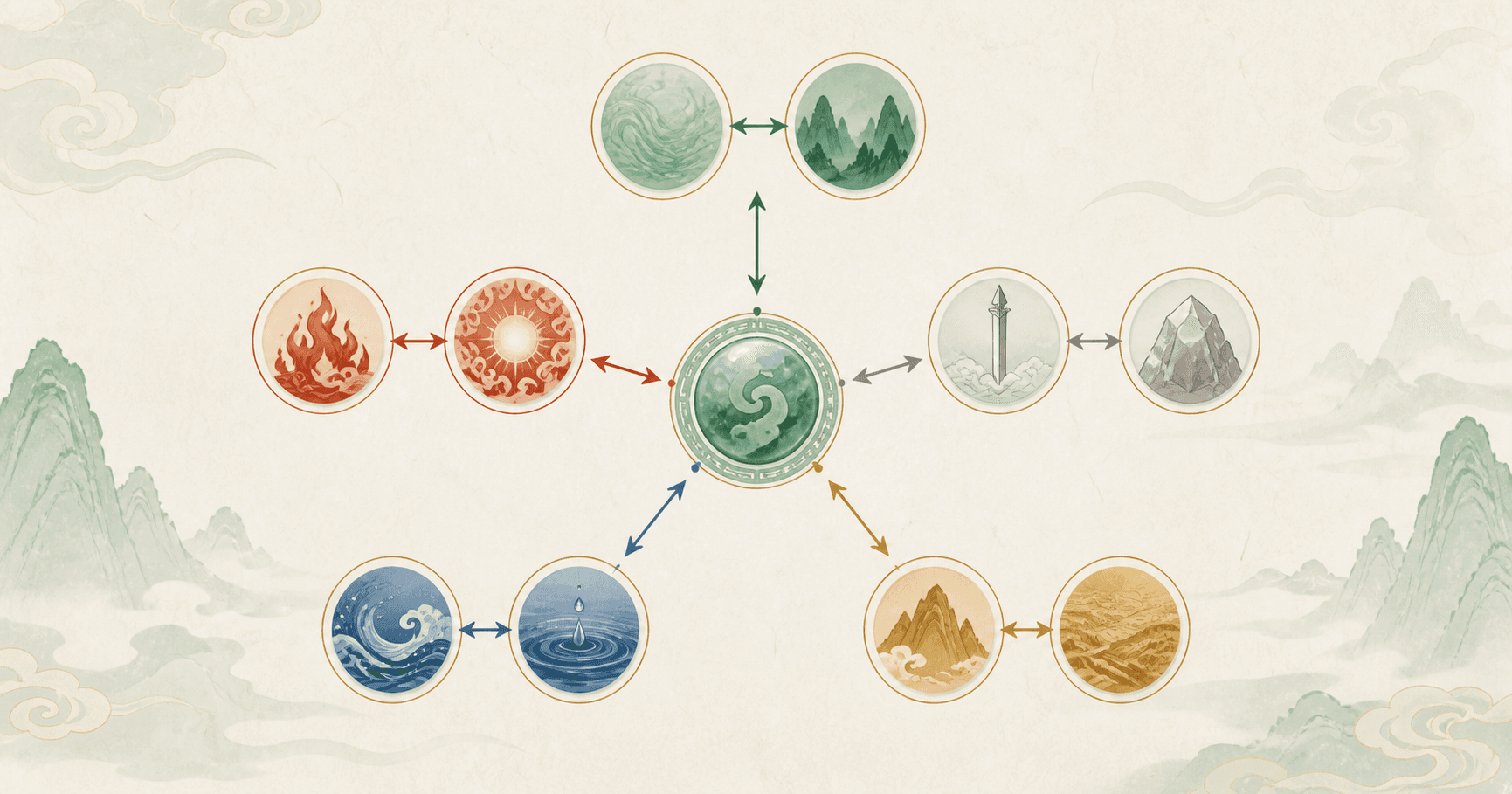
The Ten Gods are not separate from the Five Elements; they are elemental relationships classified around the Day Master. For Jia Wood, Wood is Peers, Fire is Output, Earth is Wealth, Metal is Officer, and Water is Resource.
If the Day Master changes to Bing Fire, the mapping changes too. Water can be Resource, Officer, Wealth, Output, or Peer for different Day Masters, which is why the Day Master must come first.
How Are the Ten Gods Used in Personality Readings?
The Ten Gods are often used to discuss personality and behavior, but they are not fixed personality labels. Strong Output does not guarantee expressive skill, strong Officer does not prove a love of rules, and strong Resource does not guarantee learning ability.
Read strength, position, visibility in the stems, other elemental interactions, the Day Master's condition, season, and the whole chart. The Ten Gods are better understood as relational patterns and tendencies than as a personality test.
Can the Ten Gods Read Career, Wealth, and Relationships?
Traditional Bazi does use the Ten Gods to discuss career, wealth, relationships, and family. Wealth offers clues about resources and outcomes, Officer about duty and pressure, Output about expression and creation, and Resource about learning and support.
No Ten God directly equals a life result. Direct Wealth does not guarantee riches, Direct Officer does not guarantee office or power, and prominent Output does not guarantee a creative career. These are analytical clues, not fixed outcomes.
Is More of a Ten God Better?
No. Bazi has no rule that more of a given Ten God is always better. Greater quantity may make a theme more visible, but whether it helps depends on what the chart needs.
An absent Ten God does not prove the absence of a related ability or experience. Look at where it appears, how strong it is, and what relationships it forms rather than relying on counts.
How Do the Ten Gods Relate to Luck Pillars and Annual Influences?
The natal Ten-God structure is relatively fixed, but Luck Pillars and annual influences introduce new stems and branches, which form new Ten-God relationships to the Day Master.
Traditional analysis asks which Ten Gods strengthen, what new interactions form, whether the natal structure changes, and which themes become more prominent. The Ten Gods are therefore important in time-cycle analysis as well.
How Should Beginners Learn the Ten Gods?
The most effective method is not to memorize many formulas first, but to learn the five relationships—same as self, produced by self, controlled by self, controls self, and produces self—and their two Ten Gods.
Then find your Day Master and classify the chart's other elements. Once you can explain why one character is Wealth and another is Resource, learning position, strength, and combinations becomes easier than memorizing isolated definitions.
- Same as the Day Master: Friend and Rob Wealth
- Produced by the Day Master: Eating God and Hurting Officer
- Controlled by the Day Master: Direct Wealth and Indirect Wealth
- Controls the Day Master: Direct Officer and Seven Killings
- Produces the Day Master: Direct Resource and Indirect Resource
Summary
The Ten Gods are a classification system built around the Day Master from elemental interaction and yin-yang polarity. They are not ten fixed destinies or simple favorable-unfavorable labels, but a language for describing relationships in the chart.
Find the Day Master first, understand the Five Elements, and always return each Ten God to the whole chart. Once the five relationships are clear, the Ten Gods become a practical tool for reading Bazi.