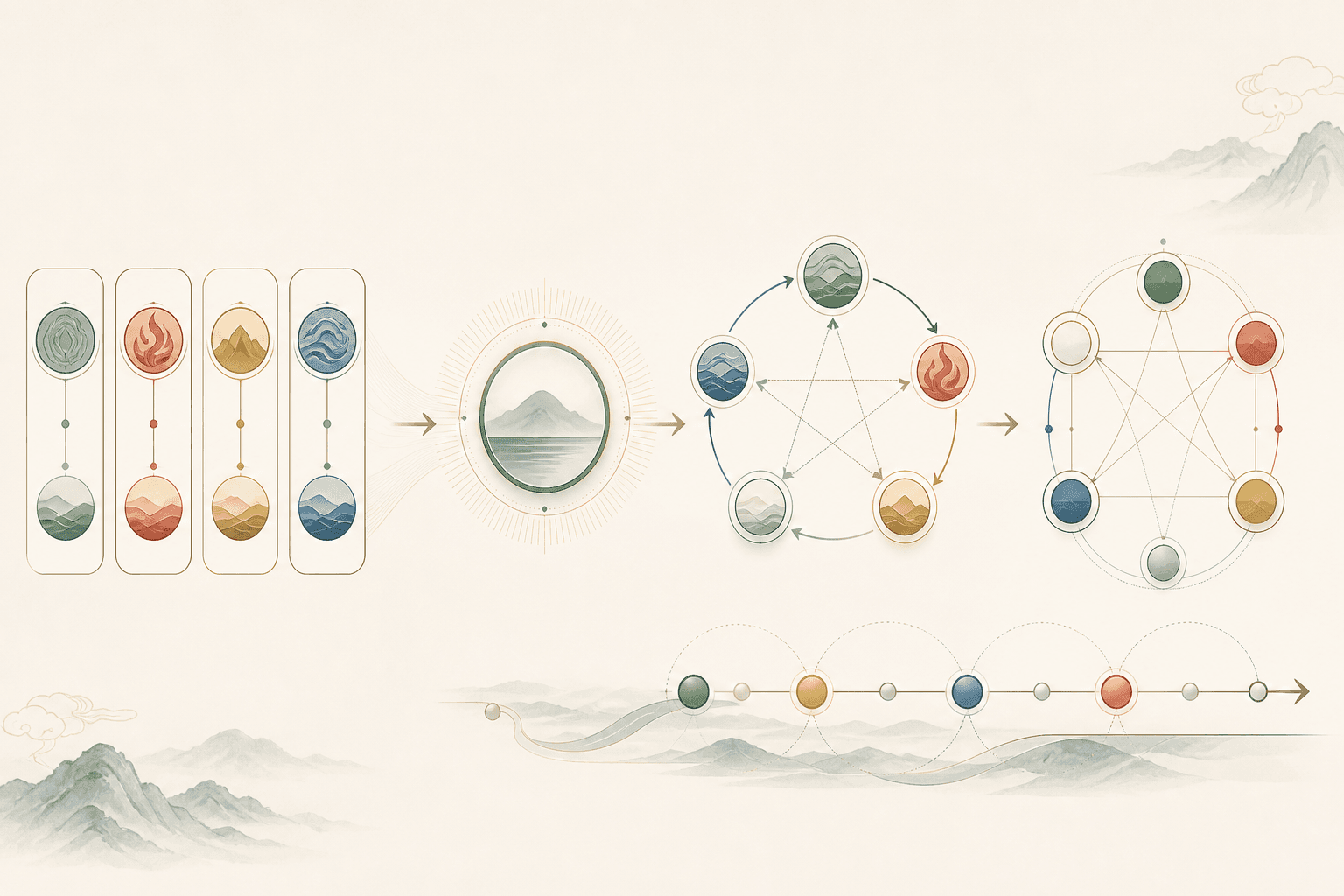
A first look at a Bazi chart can feel crowded with stems, branches, the Day Master, Ten Gods, hidden stems, elements, and luck cycles. Reading it is not a matter of assigning an isolated meaning to every symbol; it requires a stable sequence.
Start with the Four Pillars and Day Master, then establish season and element strength, examine Ten Gods and stem-branch relationships, and add luck cycles and years last. This turns a dense table into a structured relationship model.
This guide follows a beginner-friendly sequence. Each layer explains what to observe, why it belongs at that point in the process, and which popular shortcuts can oversimplify the relationships described in traditional Bazi.
There is no need to label a symbol good or bad at first sight. Confirm the calculation convention, then place quantity, season, position, strength, and timing in one structure to see how the information works together.
Later sections address career, wealth, relationships, symbolic stars, and common calculator differences while explaining why traditional symbolic analysis cannot replace real-world judgement.
Every step should ultimately be checked against the relationships in the same complete chart.
Step 1: Confirm the Four Pillars
A complete chart has Year, Month, Day, and Hour Pillars, each containing one Heavenly Stem and one Earthly Branch. Before interpretation, verify the birth date, time, place, time zone, and solar-term boundaries because different inputs or boundary rules can change a pillar.
The four pillars correspond to the year, month, day, and hour of birth. The first task is not to judge whether a life is good or bad, but to confirm that the chart itself is correct.
An incorrect birth time can change the Hour Pillar, while a birth near a solar-term boundary can change the Year or Month Pillar. Accurate chart calculation is therefore the foundation of every later interpretation.
- Birth date
- Birth time
- Birthplace
- Historical time zone at the birthplace
- Solar-term transition boundaries
| Pillar | Year | Month | Day | Hour |
|---|---|---|---|---|
| Stem | Jia | Bing | Xin | Wu |
| Branch | Zi | Yin | You | Xu |
Step 2: Find the Day Master
The Day Master is the Heavenly Stem of the Day Pillar. A Jia-Zi day has a Jia Wood Day Master, while Ding-You has Ding Fire. Other elements are classified by how they support, drain, control, or match this reference, which later produces the Ten Gods.
For example, a Jia-Zi Day Pillar has a Jia Wood Day Master; Ding-You has Ding Fire; and Xin-Chou has Xin Metal.
Many chart relationships are defined from the Day Master's point of view. Other elements may match it, generate it, be generated by it, control it, or be controlled by it; these relationships are then refined into the Ten Gods.
Step 3: Identify the Day Master's Element
The ten stems belong to Wood, Fire, Earth, Metal, or Water and also carry yin or yang polarity. Naming the Day Master is only a starting point: the same stem can behave very differently across seasons and surrounding element structures.
Jia and Yi are Wood; Bing and Ding are Fire; Wu and Ji are Earth; Geng and Xin are Metal; Ren and Gui are Water. Each pair contains one yang and one yin stem.
Knowing only that the Day Master is Jia Wood, Bing Fire, or Xin Metal is not a complete analysis. The next question is what seasonal and elemental environment surrounds it.
| Stem | Element | Polarity |
|---|---|---|
| 甲 | Wood | Yang |
| 乙 | Wood | Yin |
| 丙 | Fire | Yang |
| 丁 | Fire | Yin |
| 戊 | Earth | Yang |
| 己 | Earth | Yin |
| 庚 | Metal | Yang |
| 辛 | Metal | Yin |
| 壬 | Water | Yang |
| 癸 | Water | Yin |
Step 4: Read the Month Command
The Month Branch is the month command and closely tracks season, making it central to assessing element strength. Rather than merely counting Wood, ask what season it occupies, whether it has roots, and whether other elements support it.
Earth can play different roles during seasonal transitions. A Jia Wood Day Master born in spring will generally receive more seasonal support than the same Jia Wood born amid the stronger Metal influence of autumn.
The month command is not merely a month label. It indicates seasonal timing and keeps element counts grounded in season, roots, and support.
- Wood is generally stronger in spring
- Fire is generally stronger in summer
- Metal is generally stronger in autumn
- Water is generally stronger in winter
Step 5: Examine the Five Elements
Observe how Wood, Fire, Earth, Metal, and Water appear in stems, branches, and hidden stems. Quantity alone is not strength; season, support, output, drain, and control form the dynamic structure.
Both stems and branches carry element associations. A branch's primary element is a useful beginner reference, but its hidden stems mean a full reading cannot stop at this basic table.
For example, Wood can be supported by Wood and generated by Water; Fire can be supported by Fire and generated by Wood; Metal can be supported by Metal and generated by Earth. Wood producing Fire drains Wood, while Metal controlling Wood applies pressure. Generation, control, output, and drain form a dynamic system.
| Branch | Primary element |
|---|---|
| Yin | Wood |
| Mao | Wood |
| Si | Fire |
| Wu | Fire |
| Chen | Earth |
| Xu | Earth |
| Chou | Earth |
| Wei | Earth |
| Shen | Metal |
| You | Metal |
| Hai | Water |
| Zi | Water |
Which elements appear most?
Use counts as a first observation, not as a final strength verdict.
Does the Day Master receive support?
Peer elements and elements that generate the Day Master can support it, subject to season and position.
Is the Day Master drained or controlled?
Elements produced or controlled by the Day Master, and elements that control it, all change the balance.
Step 6: Do Not Treat a Missing Element as a Prescription
An absent element is not automatically what a chart needs. Absence and usefulness are different questions; usefulness depends on season, Day Master condition, stem-branch relationships, and the whole structure.
Many calculators count Wood, Fire, Earth, Metal, and Water, which can make absence look like a prescription. For example, a chart may contain no obvious Water, yet if its overall climate is already cold, adding more Water may not fit the traditional balancing logic.
Conversely, an element already present can still remain important. What is missing describes surface structure; what is useful requires season, Day Master condition, stem-branch relationships, and the whole chart.
Step 7: Assess Day Master Strength
Strong and weak describe how much support, drain, and control the Day Master receives. They are not ratings of health, personality, or life quality.
Strength assessment usually considers seasonal support, roots, assistance, and the amount of control, output, and drain. No single factor should decide the conclusion by itself.
A strong Day Master does not mean a good life, and a weak one does not mean a bad life. The important questions are whether the structure is coordinated and what role each element plays.
Seasonal support
Check whether the birth season supports the Day Master.
Roots in branches
Check whether the Day Master has roots in the branches.
Support from other elements
Check peer and resource elements that support it.
Control, output, and drain
Compare the forces that drain or control the Day Master.
Step 8: Read the Ten Gods
The Ten Gods are relationship categories, not deities. Start with five element relationships, then distinguish their yin and yang forms.
The full Ten Gods are Friend, Rob Wealth, Eating God, Hurting Officer, Indirect Wealth, Direct Wealth, Seven Killings, Direct Officer, Indirect Resource, and Direct Resource. They name relationships rather than deities or fixed personality types.
For a Wood Day Master: other Wood is the same as me; Wood producing Fire is produced by me; Wood controlling Earth is controlled by me; Metal controlling Wood controls me; and Water producing Wood produces me. Learn these five relationships before their yin-yang refinements.
Same as me: Friend and Rob Wealth
Peer elements are traditionally linked with independence, competition, partnership, and selfhood.
Produced by me: Eating God and Hurting Officer
Output elements are traditionally associated with expression, creativity, and production.
Controlled by me: Direct and Indirect Wealth
Wealth categories can concern resources, practical outcomes, and relationship patterns—not only money.
Controls me: Direct Officer and Seven Killings
Officer categories are often used to discuss rules, responsibility, constraint, pressure, and competition.
Produces me: Direct and Indirect Resource
Resource categories are often connected with learning, support, knowledge, protection, and thought.
Step 9: Never Read a Ten God in Isolation
Direct Wealth does not guarantee money, Seven Killings is not automatically harmful, and Hurting Officer is not a fixed personality label. Read quantity, position, strength, season, Day Master relationship, and the full structure together.
A responsible Ten God reading considers quantity, position, strength, seasonal support, relationship to the Day Master, other stem-branch influences, and whether the chart forms a particular structure.
The same Ten God may function very differently across charts. Understand the relationship first and interpret it within the whole chart instead of drawing a conclusion from a label.
Step 11: Examine Stem Relationships
Look for combinations, control, and repeated peer stems. The five common pairings do not automatically transform; transformation depends on season and the strength of the wider chart.
The five stem combinations are Jia-Ji, Yi-Geng, Bing-Xin, Ding-Ren, and Wu-Gui. A beginner should first read them as special interactions between two stems, not as guarantees of a specific life event.
A combination does not automatically transform. Transformation still depends on season, elemental strength, and the complete chart.
Step 12: Examine Branch Relationships
Branches can combine, clash, punish, harm, or break. A clash indicates a strong interaction, not an automatic disaster; a combination is not automatically beneficial. Position, element role, and timing determine meaning.
The six common clashes are Zi-Wu, Chou-Wei, Yin-Shen, Mao-You, Chen-Xu, and Si-Hai. A clash more often signals strong interaction, change, or structural movement; it should not be equated automatically with disaster.
Interpretation depends on the position involved, the elements, whether the Day Master receives help or pressure, whether the natal chart benefits from the change, and whether luck cycles or years trigger it again. Combination is not always good, and clash is not always bad.
- Combination
- Clash
- Punishment
- Harm
- Break
Step 13: Consider Pillar Position
The same element or Ten God can be viewed differently by pillar position, but position never overrides the complete chart.
The Year Pillar is often used for ancestry, early life, and the wider social setting; the Month Pillar for upbringing, parental influence, work environment, and social structure; the Day Pillar for the Day Master, personal life, and close relationships; and the Hour Pillar for later development, long-term goals, children, inner thought, and later life.
These are traditional viewing angles rather than stand-alone verdicts. The Month Branch also serves as the month command and therefore remains important for season and strength.
Year Pillar
Often associated with ancestry, early life, and the wider social setting.
Month Pillar
Often connected with upbringing, work environment, and the month command.
Day Pillar
Its stem is the Day Master; its branch is often used for personal and close-relationship themes.
Hour Pillar
Often extended to later development, long-term aims, children, and inner thought.
Step 14: Judge the Whole Structure
Move from isolated symbols to a relationship system: Day Master condition, dominant elements, support and pressure, climatic qualities, concentrated Ten Gods, major combinations, and flow all need context.
At this point, stop asking how many Direct Wealth markers appear and ask what relationship system the elements and Ten Gods form together. Bazi is closer to a relational model than a fixed keyword lookup table.
- The Day Master's condition
- Which elements dominate, support, or pressure
- Whether the chart tends cold, hot, dry, or damp
- Whether a Ten God category is concentrated
- Whether major interactions form and energy can flow
Step 15: Only Then Consider Useful and Unhelpful Elements
Useful elements are traditionally those that help regulate a particular structure, while unhelpful ones can reinforce imbalance. They cannot be derived from a simple missing-element rule, and schools may differ in method.
Only after analysing the Day Master, month command, strength, and whole structure does traditional Bazi move to favourable, useful, and unfavourable elements. The first two generally help regulate a particular chart, while the last may intensify imbalance.
This is a complex area and schools may use different methods. More important than rushing to obtain a useful-element label is understanding why an element helps or hinders this particular chart.
Step 16: Read Luck Cycles
The natal chart stays fixed while each luck cycle adds a stem and branch. Examine how a cycle affects the Day Master, interacts with the natal chart, reinforces existing patterns, or changes structural emphasis.
Each luck cycle adds a new stem and branch that interact with the natal chart. Examine its elements, its effect on the Day Master, its combinations, clashes, punishments, or harms, and whether it reinforces existing traits or changes the structure.
For example, if one element already dominates the natal chart, a luck cycle of the same element may strengthen that pattern. Whether this helps or hinders still depends on the natal structure.
Step 17: Read the Annual Influence Last
An annual influence is the stem and branch of a year. Read it only as natal chart plus luck cycle plus year; predicting from the year alone strips away the structure that gives it context.
The natal chart represents the base structure formed at birth, a luck cycle represents the environment of a life phase, and the annual influence adds a specific year's conditions. A year cannot be read from its zodiac animal or annual pillar alone.
Annual analysis comes late in the sequence. Predicting a year's events before understanding the natal chart produces oversimplified and potentially deterministic conclusions.
A Reliable Bazi Chart Reading Order
A stable order is: verify pillars, find the Day Master, establish the month command, assess elements and strength, read Ten Gods and hidden stems, examine relationships, synthesize the structure, and only then add luck cycles and years.
This sequence is more stable than interpreting whichever symbol catches the eye, because every step supplies context for the next one.
- Confirm the Year, Month, Day, and Hour Pillars
- Find the Day Master in the Day Stem
- Use the month command for season and elemental environment
- Observe element distribution and strength
- Compare support with control, output, and drain
- Understand the Ten God relationships
- Add hidden-stem information
- Analyse combinations, clashes, punishments, harms, and breaks
- Synthesize the whole structure
- Add luck cycles and annual influences last
How Is Career Discussed in a Bazi Chart?
Career is not read from the Officer category alone. Traditional analysis combines the Day Master, Officer, Resource, Output, and Wealth systems with season, structure, and timing. Real career choices still depend on skills, interests, education, experience, opportunity, income, location, and goals.
Some charts are traditionally read as emphasizing rules, organisation, and responsibility, while others emphasize output, creativity, or independence. These are symbolic tendencies, not direct assignments to a specific occupation.
Real career decisions must also consider skills, interests, education, experience, industry opportunity, income, location, and personal goals. Bazi can be one traditional reflective perspective, not the sole basis for a career choice.
How Is Wealth Discussed in a Bazi Chart?
Wealth categories are not bank balances. Their presence, strength, relationship to the Day Master, other Ten Gods, and timing all matter. Actual wealth also depends on work, markets, decisions, and risk management.
Traditional analysis asks whether Wealth appears, how strong it is, whether the Day Master can carry it, how other elements affect it, how it relates to the other Ten Gods, and whether luck cycles or years change the structure.
Many Wealth markers do not guarantee money; no obvious Wealth marker does not mean there can be no wealth. Actual finances also depend on occupation, industry, ability, the economy, investment decisions, and risk management.
How Are Relationships Discussed in Bazi?
Traditional relationship analysis combines the Day Pillar and Branch, relevant Ten Gods, auxiliary markers, stem-branch interactions, and timing. Treat it as symbolic reflection on patterns, not a certain prediction of marriage, separation, or a specific partner.
Modern readers can treat this area as a traditional symbolic analysis of relationship patterns and changing phases. No single combination can establish that marriage, separation, or a particular partner will occur.
Real relationships are ultimately shaped by communication, values, environment, choices, and both people's behaviour. A chart cannot replace lived experience, consent, or real-world evidence.
How Should Symbolic Stars Be Read?
Symbolic stars such as Peach Blossom, Traveling Horse, and Nobleman are auxiliary systems. Beginners should establish the Day Master, season, elements, Ten Gods, and natal structure before using them as secondary context.
Many calculators highlight auxiliary markers such as Peach Blossom, Traveling Horse, Canopy, Nobleman, Academic Star, and Yang Blade. Counting these first risks mistaking secondary information for the chart's main structure.
A better order is to establish the natal structure first and use symbolic stars only as supplementary context. They do not replace the Day Master, month command, elements, Ten Gods, or stem-branch relationships.
Why Can Bazi Calculators Produce Different Results?
Different results usually come from solar-term boundaries, day-boundary rules, historical time zones, daylight saving time, or true-solar-time conventions. Verify calculation rules before interpreting a boundary-sensitive birth time.
Different results from the same birth data do not necessarily mean one interpretation is wrong; the underlying calculation conventions may differ. Births near time, date, or solar-term boundaries are especially sensitive.
Month Pillars normally use solar terms rather than Gregorian or lunar months; births near 23:00 may invoke different day boundaries; overseas births require historical time zones; some places and years require daylight saving time; and some schools correct to true solar time by longitude.
Solar terms
Month Pillars normally follow solar terms rather than calendar months.
Day boundary
Schools may use different day-boundary conventions near 23:00.
Time zone
Overseas births require the historical zone at the birthplace.
Daylight saving time
Ignoring historical daylight saving can shift the effective time.
True solar time
Some conventions further correct time using longitude and the equation of time.
Common Beginner Mistakes
Each mistake reduces a relationship system to a single label and should be checked deliberately.
Element counts are surface information because strength also depends on season, hidden stems, roots, and relationships. Absence is not usefulness, and strength is not a life-quality score.
Combinations and clashes are interactions without absolute meaning outside the whole chart; one Ten God cannot define a personality; annual influences require the natal chart and luck cycle; and Bazi should not be treated as a method that certainly predicts specific events.
Only counting elements
Strength also depends on season, hidden stems, roots, and relationships.
Adding whatever is missing
Absence and usefulness are not the same.
Treating weakness as bad
Strength is not a life-quality score.
Combination good, clash bad
Interactions have no absolute meaning outside context.
One Ten God defines personality
Ten Gods require strength, position, and combination context.
Reading a year without the natal chart
A year must be read with the natal chart and luck cycle.
Treating Bazi as deterministic prediction
Bazi is a traditional system, not a certain forecast of specific future events.
Can You Learn to Read Your Own Bazi Chart?
Yes—learn in stages. Master the pillars, Day Master, month command, elements, Ten Gods, and hidden stems before moving to strength, relationships, structures, useful elements, luck cycles, and years. Understanding why an element plays a role matters more than memorizing slogans.
Beginners do not need to judge complex structures or useful elements immediately. Learn the pillars, Day Master, month command, elements, Ten Gods, and hidden stems first, then move to strength, relationships, structures, useful elements, luck cycles, and years.
Reading Bazi is not about accumulating slogans. It is about explaining why an element plays a particular role in this chart; answering that question marks the beginning of structural understanding.
Summary
Read a Bazi chart layer by layer: pillars, Day Master, month command, elements, strength, Ten Gods, hidden stems, relationships, whole structure, luck cycles, and years. Verify the chart first, then understand relationships, and add timing last. Use Bazi as a traditional framework for reflection, not as a substitute for evidence or major decisions.
First verify the birth data and pillars. Then find the Day Master, identify its season, support, drain, and control. Use the Ten Gods, hidden stems, and stem-branch relationships to understand the whole chart, and add luck cycles and years only at the end.
A beginner does not need to pursue precise predictions. Start with three questions: What is my Day Master? Which elements matter most in this chart? What relationships do they form? Clear answers make a complex chart easier to understand.