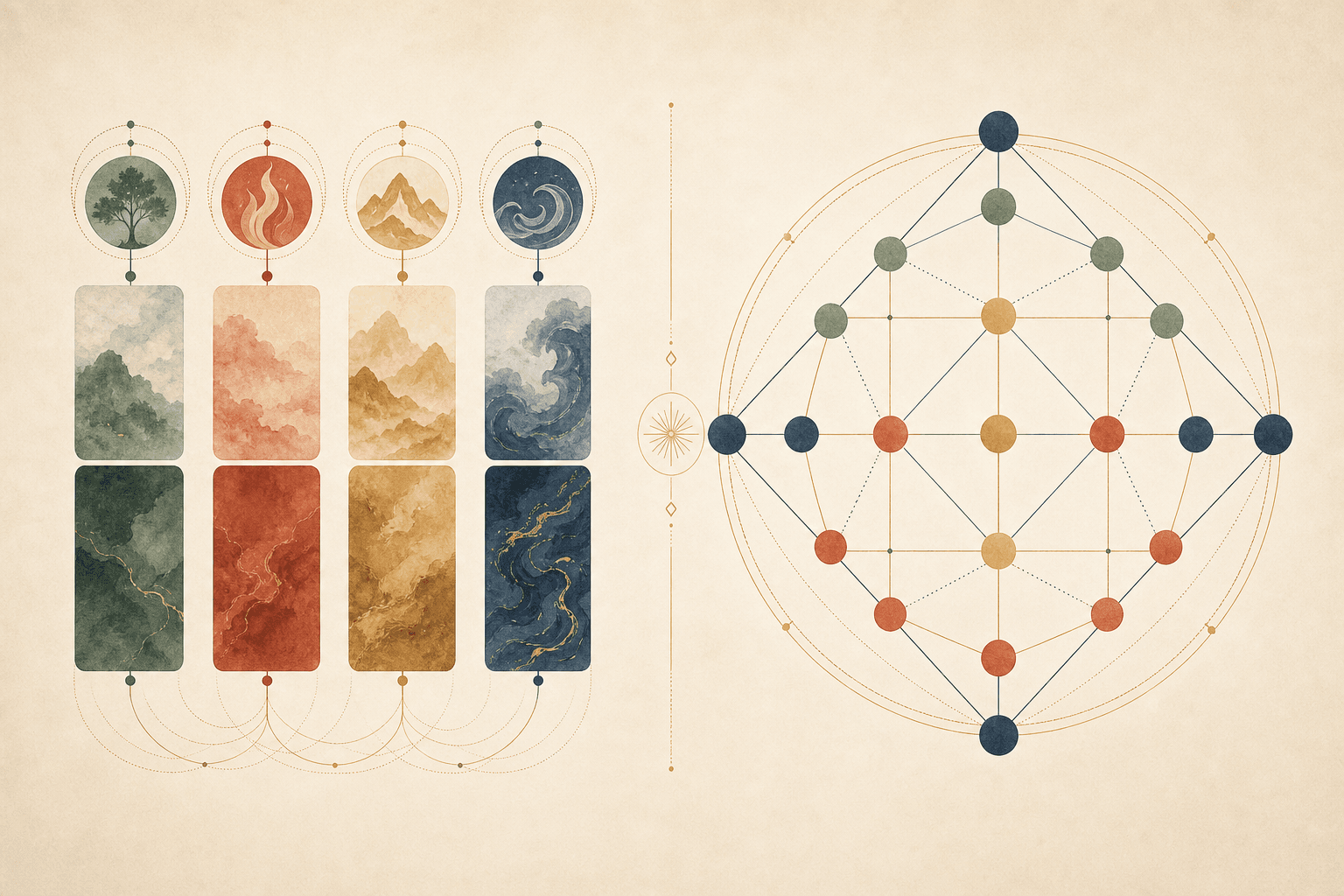
Bazi and the Destiny Matrix, also called the Matrix of Destiny, both use birth information to create a personal chart, but they come from different systems.
Bazi is a traditional Chinese Four Pillars system, while the Destiny Matrix is a modern numerology framework commonly connecting birth-date numbers with 22 Tarot Major Arcana archetypes.
What Is Bazi?
Bazi converts a person’s birth year, month, day, and hour into the Year, Month, Day, and Hour Pillars. Each contains one Heavenly Stem and one Earthly Branch, creating the Eight Characters.
A reading examines the Day Master, Five Elements, Ten Gods, Stem-Branch relationships, Luck Pillars, and annual influences. Birth time, seasonal markers, and time-zone calculations can affect the chart.
What Is the Destiny Matrix?
The Destiny Matrix primarily uses numbers derived from a person’s date of birth to generate a visual numerical chart.
Common versions connect numbers with 22 Major Arcana archetypes and use chart positions to interpret personality, relationships, money, life lessons, and personal development. Calculations can vary between platforms.
What Is the Main Difference?
The two systems may explore similar life themes, but they use entirely different frameworks.
- Bazi: Birth Date and Time → Four Pillars → Stems and Branches → Five Elements and Ten Gods
- Destiny Matrix: Birth Date → Numerical Calculation → Matrix Positions → Number or Arcana Meanings
Which One Should You Use?
Choose Bazi to explore the Five Elements, Day Master, Ten Gods, and Luck Pillars. Choose the Destiny Matrix if you prefer numerology, Tarot archetypes, and a visual matrix.
Both are better approached as symbolic tools for self-reflection rather than guaranteed methods of predicting future outcomes.
Summary
Bazi is built around the Four Pillars, Heavenly Stems, Earthly Branches, and Five Elements. The Destiny Matrix is generally built around birth-date numbers, matrix positions, and 22 archetypal energies. Understanding each system is more useful than asking which is more accurate.