
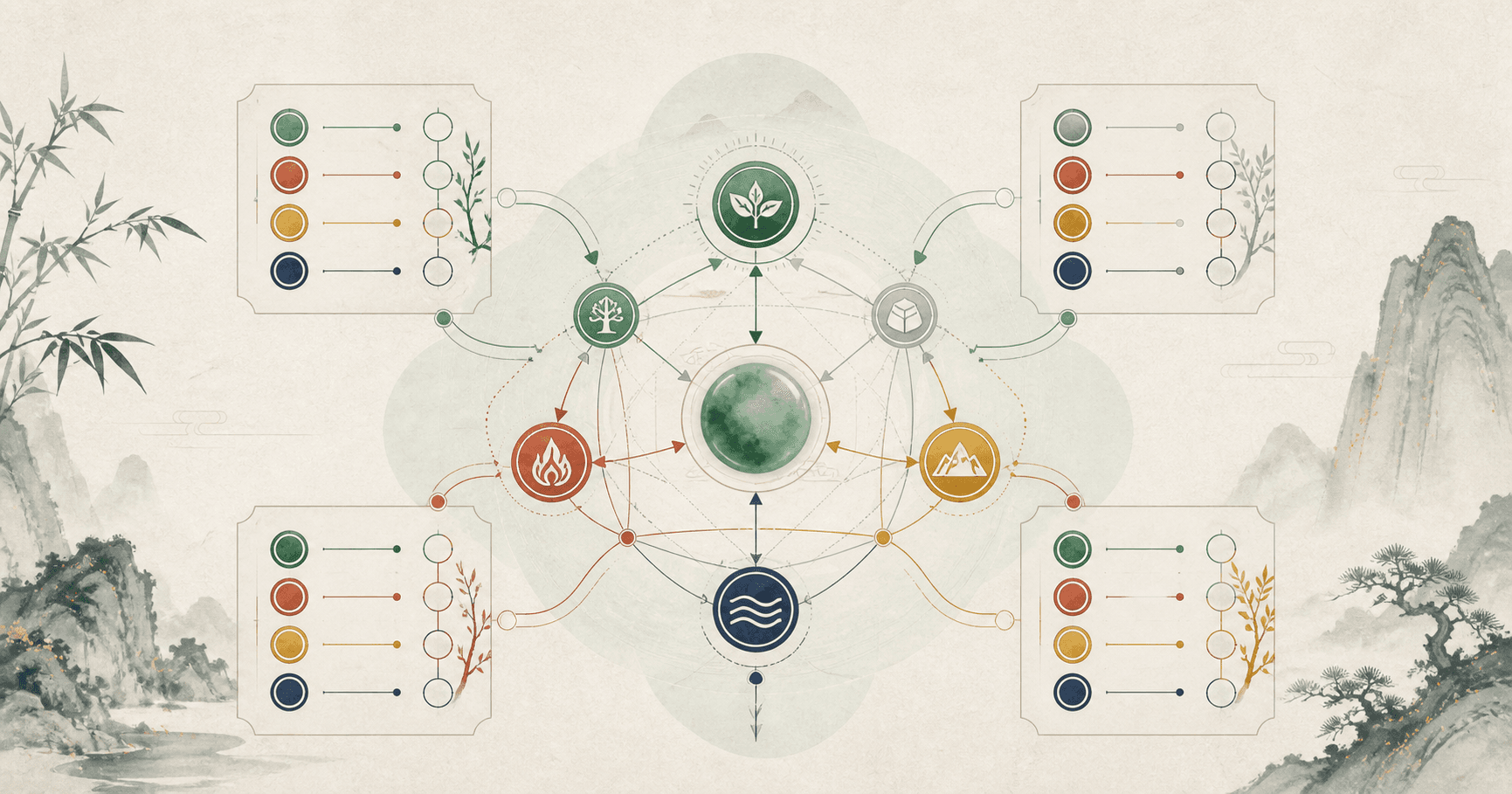
A chart pattern is a common and easily misunderstood concept in Bazi. It is not a fixed life label such as a rich, difficult, or prestigious destiny.
Traditional Bazi classifies the chart's main structure through the Day Master, Month Command, Ten Gods, elemental strength, and stem-branch relationships. In simple terms, the pattern is the chart's most representative structural mode.
Its purpose is not to pronounce a life good or bad, but to identify the most prominent forces, how the elements and Ten Gods cooperate, and what basic relationship the chart presents.
How Is a Bazi Pattern Identified?
A pattern is not identified from one character. It is read from all four pillars, including the Day Master, Month Command, seasonal strength, visible Ten Gods, Day-Master strength, elemental interactions, and important stem-branch combinations.
The Month Command is often the starting point. As the branch of the Month Pillar, it represents the seasonal environment, which strongly affects elemental strength and the chart's structure.
- Day Master and Month Command
- Strongest seasonal force
- Ten Gods visible in the stems
- Day-Master strength
- Elemental interactions and major combinations
How Does the Pattern Relate to the Day Master?
The Day Master is the stem of the Day Pillar and the chart's center. For Jia Wood, the other elements form Peer, Output, Wealth, Officer, and Resource; pattern analysis asks what main structure these forces form around it.
Knowing that the Day Master is Jia Wood, Bing Fire, or Xin Metal does not identify the pattern. The Day Master names the center; the pattern describes the whole structure.
What Are Common Bazi Patterns?
Traditional Bazi uses several classification methods, and schools may differ. A common family of patterns uses the Month Command and Ten Gods: Direct Officer, Seven Killings, Direct or Indirect Wealth, Eating God, Hurting Officer, and Direct or Indirect Resource.
- Direct Officer pattern: associated with rules, duty, order, and constraint; merely having Direct Officer does not establish the pattern or guarantee status.
- Seven Killings pattern: associated with competition, pressure, challenge, and decisiveness; it is not automatically harmful and depends on regulation within the chart.
- Wealth patterns: involve resources, tangible outcomes, and management; they do not guarantee riches and must fit the Day Master and whole chart.
- Output patterns: often connected with expression, creativity, skill, and performance, but do not determine a personality or career.
- Resource patterns: often connected with learning, knowledge, support, protection, and ways of thinking.
Does Having a Ten God Establish Its Pattern?
No. Direct Officer in a chart does not automatically create a Direct Officer pattern, and Indirect Wealth does not automatically create an Indirect Wealth pattern. Most charts contain several Ten Gods.
Ask whether it is seasonally supported, structurally dominant, visible in a stem, seriously disrupted, and coherent with the Day Master and other elements. Presence and pattern formation are different concepts.
What Are Special Patterns?
Beyond common Officer, Wealth, Output, and Resource patterns, traditional Bazi discusses special structures such as Following and Dominant patterns. These normally require a clear, sometimes extreme concentration of force.
A large amount of one element is not enough to declare a Following pattern, and a software label is not proof. Special-pattern criteria are generally stricter.
Is a Pattern the Same as Day-Master Strength?
No. Strength describes the Day Master's condition; a pattern describes the chart's broader structure. A Day Master can be strong or weak while still participating in a particular pattern.
Strength is a power assessment; pattern is a structural assessment. They are related but not identical.
Are Some Patterns Simply Good or Bad?
Traditional analysis asks whether a pattern is established, damaged, or well supported, but it should not be reduced to one pattern always being good and another bad. The same pattern can behave very differently in different charts.
The important question is whether the structure is coherent and its forces work together effectively.
Does the Pattern Change with Luck Pillars?
The natal chart and its basic structure are fixed, but Luck Pillars and annual influences add new stems and branches that may reinforce, challenge, or adjust it. Traditional analysis reads the natal chart first, then each phase.
The appearance of a Ten God in one year does not mean the natal pattern has completely changed into another type.
Why Do Chart Tools Show Different Patterns?
Differences can come from school-specific rules, treatment of Hidden Stems in the Month Command, visibility and strength criteria, or simplified software algorithms. A pattern label is not a universally identical datum like a birth date.
When tools disagree, compare their stated rules rather than only their final labels.
How Should Beginners Read Their Pattern?
Beginners should build the analysis in sequence rather than applying a pattern name as soon as one Ten God appears.
- Step 1: Identify the Day Master and its element.
- Step 2: Read the Month Command and seasonal force.
- Step 3: Identify the most prominent Ten-God relationships.
- Step 4: Assess whether the Day Master can carry the chart's forces.
- Step 5: Read the whole structure before deciding whether a pattern is established.
Summary
A Bazi pattern is a traditional classification of the chart's main structure, not a life label and not something determined by one stem, branch, or Ten God. It requires the Day Master, Month Command, elemental strength, Ten Gods, relationships, and whole chart.
The Day Master is the center, the Month Command a foundation, the Ten Gods the relational language, and the pattern the structure they form together. The useful question is not only 'What is my pattern?' but 'Why and how is it established?'