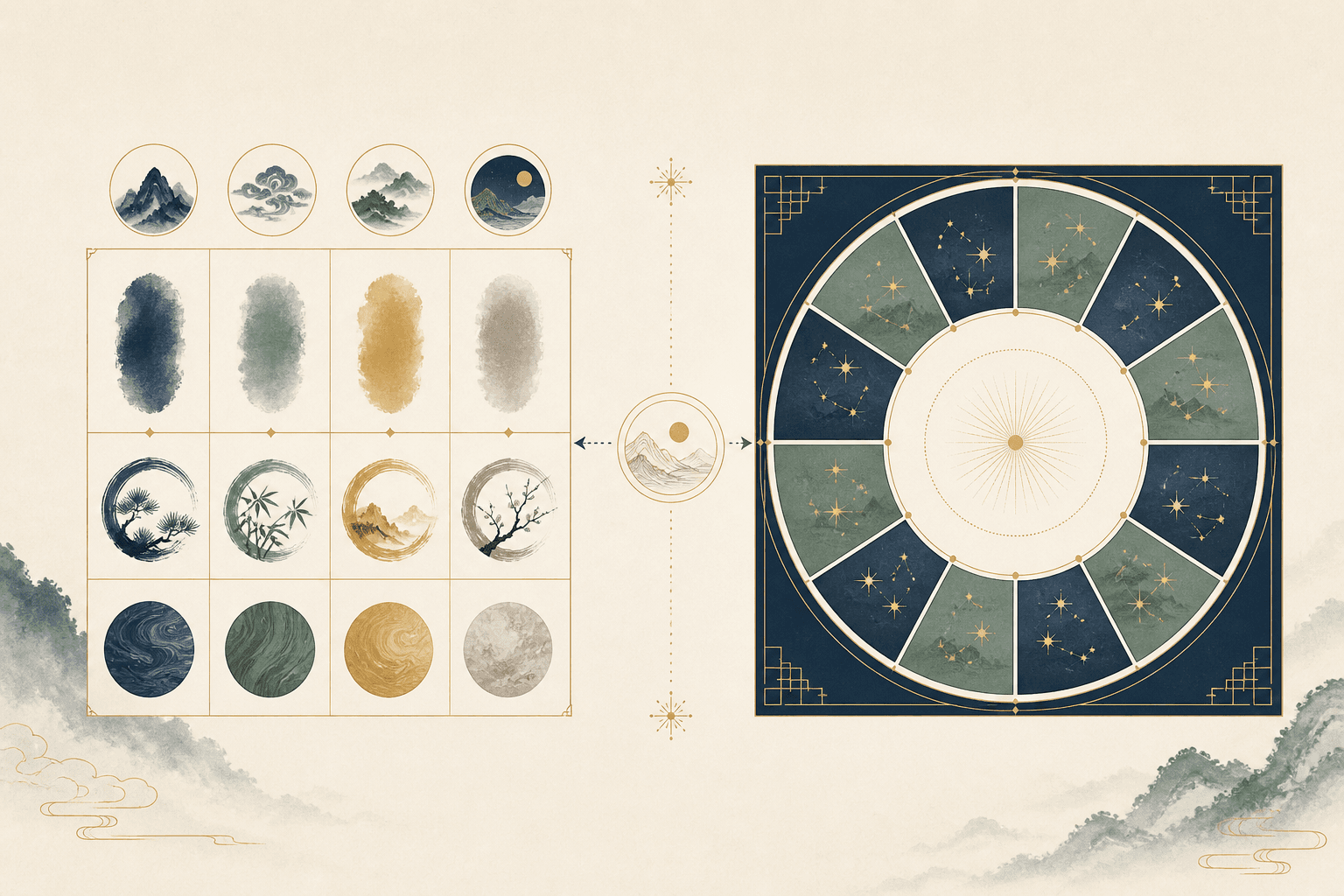
Bazi and Zi Wei Dou Shu both use birth information and belong to traditional Chinese destiny-analysis systems, but they construct and interpret charts differently.
Bazi focuses on the Heavenly Stems, Earthly Branches, and Five Elements, while Zi Wei Dou Shu focuses on the Twelve Palaces and symbolic stars.
What Is a Bazi Chart?
A Bazi chart converts the birth year, month, day, and hour into the Year, Month, Day, and Hour Pillars. Each contains one Heavenly Stem and one Earthly Branch, creating the Eight Characters.
A reading commonly examines the Day Master, Five Elements, Ten Gods, Hidden Stems, Luck Pillars, and annual influences, focusing on Five Element balance, strength, and interaction.
What Is a Zi Wei Dou Shu Chart?
Zi Wei Dou Shu also uses the birth year, month, day, and hour, but organizes the result into a Twelve-Palace chart, placing stars such as Zi Wei, Tian Ji, Tai Yang, and Wu Qu into palaces by specific rules.
Common elements include the Life, Spouse, Wealth, Career, and Well-Being Palaces, major stars, Four Transformations, major periods, and annual influences.
What Is the Main Difference?
The same birth information can produce both charts, but they look different and use different systems of interpretation.
- Bazi: Four Pillars + Stems and Branches + Five Elements + Ten Gods
- Zi Wei Dou Shu: Twelve Palaces + Stars + Four Transformations + Palace Relationships
Which One Should You Use?
Neither system is always more accurate. Bazi may suit studying the Five Elements, Day Master, and Ten Gods, while Zi Wei Dou Shu may feel more intuitive through clearly defined areas such as career, relationships, and wealth.
Summary
Bazi and Zi Wei Dou Shu use the same basic birth information but organize it differently. Bazi centers on the Four Pillars and Five Element relationships, while Zi Wei Dou Shu centers on the Twelve Palaces and star relationships. They are different traditional frameworks rather than replacements.