Bazi and the Five Elements are often discussed together, but they are not the same concept.
Bazi is the Four-Pillar arrangement derived from the year, month, day, and hour of birth. The Five Elements are a foundation for analyzing the relationships among those stems and branches.
The four pillars contain eight characters, each with an elemental association, so every chart expresses interactions among Wood, Fire, Earth, Metal, and Water. Understanding this relationship is essential to reading a Bazi chart.
What Are the Five Elements?
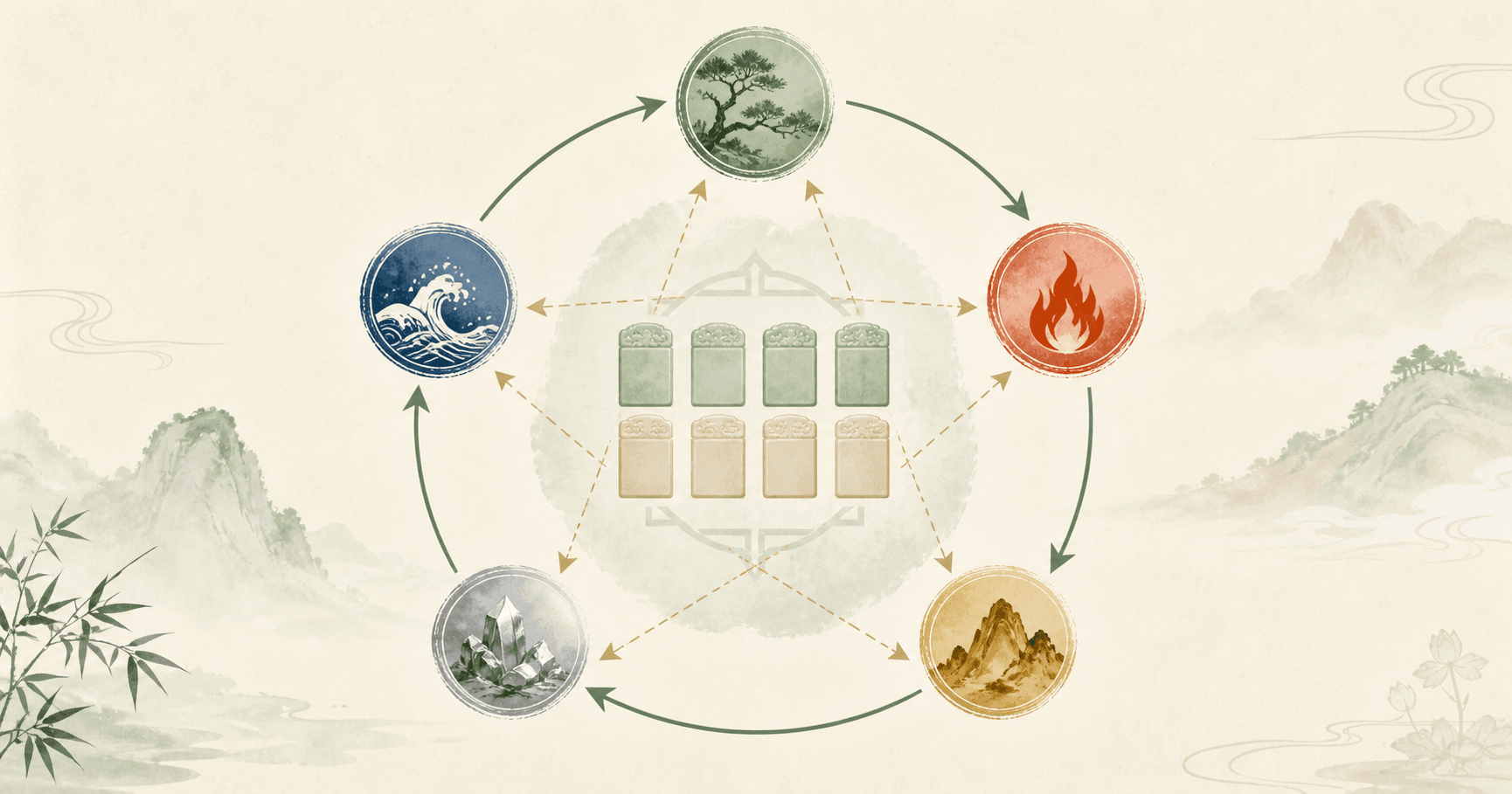
The Five Elements are Wood, Fire, Earth, Metal, and Water. In traditional thought they are not merely five substances, but a system for classifying qualities, change, and interaction.
Generation can describe support, promotion, or transformation, while control describes restraint and balance. Generation is not always favorable and control is not always harmful; the role an element plays in the particular chart is what matters.
- Generating cycle: Wood feeds Fire, Fire creates Earth, Earth bears Metal, Metal supports Water, and Water nourishes Wood
- Controlling cycle: Wood controls Earth, Earth controls Water, Water controls Fire, Fire controls Metal, and Metal controls Wood
Where Do the Elements in Bazi Come From?
The elements in Bazi come primarily from the Heavenly Stems and Earthly Branches. Each has an elemental association, so the eight visible characters provide a first view of the chart's distribution.
| Heavenly Stems | Element |
|---|---|
| Jia, Yi | Wood |
| Bing, Ding | Fire |
| Wu, Ji | Earth |
| Geng, Xin | Metal |
| Ren, Gui | Water |
Elements in the Branches and Hidden Stems
The twelve branches also have primary elemental associations. This is still only the first layer, because branches contain one or more Hidden Stems. A real elemental analysis cannot stop at the eight visible characters.
| Earthly Branches | Primary Element |
|---|---|
| Yin, Mao | Wood |
| Si, Wu | Fire |
| Chen, Xu, Chou, Wei | Earth |
| Shen, You | Metal |
| Hai, Zi | Water |
What Is the Day Master?
The central reference point is the Day Master, the stem of the Day Pillar. A Jia-Zi day has a Jia Wood Day Master, Ding-You has Ding Fire, and Geng-Chen has Geng Metal.
For a Jia Wood Day Master, Wood is the same element, Water produces Wood, Wood produces Fire, Wood controls Earth, and Metal controls Wood. These relationships develop into the Ten Gods, so elemental analysis cannot be separated from the Day Master.
Does More of an Element Always Mean Stronger?
No. Counts of Wood, Fire, Earth, Metal, and Water are surface information. The most frequent element is not necessarily the strongest, and the least frequent is not necessarily the weakest.
Strength must also be read through season—Wood is generally stronger in spring, Fire in summer, Metal in autumn, and Water in winter—along with support, roots, control, draining, combinations, and clashes.
Should You Add Whatever Element Is Missing?
'Add whatever element is missing' is a common misconception. If Water is not visible, that only describes its surface absence; it does not prove that the chart needs more Water.
A missing element may not be useful, while an element already present may still be the key regulating force. Absence is not the same as need. The task is to understand what the whole structure requires, not to collect all five elements.
What Do Elemental Strength and Weakness Mean?
Strength and weakness describe the condition of elemental forces in a chart. The Month Command—the branch of the Month Pillar—is especially important because it reflects the seasonal environment.
Also consider seasonal support, help from the same or producing elements, roots in the branches, and control or consumption. Two Jia Wood Day Masters can have very different strength; the Day Master's element alone does not settle the question.
Does Balance Mean Equal Amounts of Every Element?
No. Balance does not require each element to occupy 20 percent or appear equally often. A chart can contain more of some elements and less of others while still forming a coherent structure.
What matters is whether generation, control, and circulation work coherently. Uneven proportions do not automatically mean an unbalanced or bad chart; Bazi reads relationships, not numerical equality.
How Are the Five Elements Related to the Ten Gods?
The Ten Gods classify elemental relationships around the Day Master. For a Wood Day Master: Wood corresponds to Friend and Rob Wealth; Fire to Eating God and Hurting Officer; Earth to Direct and Indirect Wealth; Metal to Direct Officer and Seven Killings; and Water to Direct and Indirect Resource, with yin-yang polarity providing the final distinction. Learning the elements first makes the Ten Gods much clearer.
How Do the Elements Relate to Luck Cycles and Annual Influences?
The natal chart's elemental structure is fixed, but Luck Pillars and annual influences continually introduce new stems and branches that interact with it.
A chart already rich in Fire may see that force intensify during a Fire period, while a previously weak element may gain support in a new cycle. Traditional analysis follows how the natal structure changes through time rather than counting only the elements present at birth.
Can the Five Elements Describe Personality?
Traditional Bazi associates Wood with growth and action, Fire with expression and enthusiasm, Earth with stability and practicality, Metal with rules and execution, and Water with movement, thought, and adaptation.
These are traditional symbols, not deterministic labels. Abundant Fire does not prove a quick temper, and abundant Water does not prove intelligence or emotionality. Personality readings still require the Day Master, Ten Gods, positions, strength, and whole chart.
How Can You Read the Elements in Your Own Bazi Chart?
Beginners can use the sequence below without turning a high or low count into an immediate verdict or remedy.
- Step 1: Find the Day Master and identify its element.
- Step 2: Read the Month Command to understand season and environment.
- Step 3: Observe where each element appears.
- Step 4: Examine which forces support, drain, or control the Day Master.
- Step 5: Return to the whole structure rather than substituting a count for analysis.
Summary
Bazi provides the chart structure, while the Five Elements provide its basic analytical language. Every stem and branch has an elemental association, and Wood, Fire, Earth, Metal, and Water generate, control, and change in strength.
Do not stop at counts or assume a missing element must be added. Read the Day Master, season, support, control, and coherence of the whole structure. Understanding the elements first makes the Ten Gods, strength, Luck Pillars, and annual influences easier to learn.